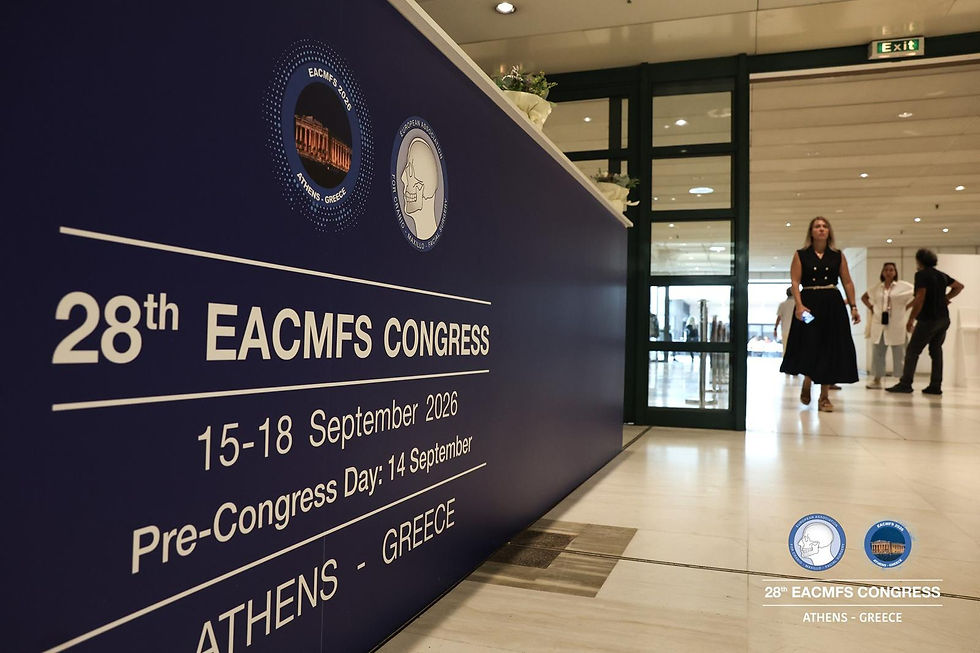
Dr Andrew Fishman Presents Parotid Gland Cancer Surgery and Facial Nerve Reconstruction at EACMFS 2026
Athens, Greece — September 2026
Prof. Dr. Andrew J. Fishman took part as a presenter at the 28th Congress of the European Association for Cranio-Maxillo-Facial Surgery (EACMFS), held in Athens in September 2026.
At this international meeting Dr. Fishman presented on the surgical treatment of parotid gland cancer and methods of facial nerve reconstruction — an area that forms an important part of complex head and neck surgery.
The EACMFS congress brought together specialists in cranio-maxillo-facial surgery, and the scientific programme covered subjects including salivary gland surgery, skull base surgery, reconstructive facial surgery, and surgical oncology and reconstruction.
Parotid gland cancer and the facial nerve
The parotid glands are the largest of the major salivary glands. They sit on both sides of the face, in front of and below the ears.
The facial nerve — the seventh cranial nerve, which controls the muscles responsible for facial movement — passes directly through the parotid gland.
That close anatomical relationship is what makes surgery for certain parotid tumours particularly complex.
For a patient with a parotid tumour, one of the key elements of surgical planning is assessing how the tumour relates to the facial nerve. Where possible, the aim is to remove the tumour while preserving nerve function. In certain malignant or advanced tumours, however, the nerve may be directly involved.
In those situations, surgical treatment may require removing part of the facial nerve together with the tumour, and planning its reconstruction.
What happens when parotid gland cancer involves the facial nerve?
Not every parotid tumour involves the facial nerve. When there is direct involvement, however, the surgeon has to balance several important goals — adequate removal of the tumour, patient safety, and preserving or restoring facial function where that is possible.
Within the parotid gland the facial nerve divides into several branches that control different facial muscles. Losing it can therefore lead to weakness or paralysis of one side of the face.
For the patient this has functional consequences, and it can also affect speech, eye closure, eating, facial expression and other everyday activities.
Assessment of the facial nerve is for that reason an important part of planning complex parotid surgery.
Facial nerve reconstruction
When the facial nerve cannot be preserved during surgery, facial nerve reconstruction may form part of the surgical plan.
There are several reconstructive methods, and the choice depends on the individual case — the site and extent of the damage, the condition of the nerve, the point at which reconstruction is possible, and other individual factors.
In certain situations, direct nerve repair, nerve grafts or nerve transfers may be used. Some patients may also need additional reconstructive procedures and rehabilitation.
The goal of reconstruction is not only to reconnect the nerve anatomically, but to achieve the best possible facial function.
Dr. Fishman's work deals with exactly these complex conditions, including cranial nerve and parotid gland surgery, salivary gland surgery, facial nerve paralysis, facial nerve rehabilitation and head and neck tumours.
Why does experience matter in complex parotid tumours?
Surgery for parotid tumours can demand precise knowledge of the anatomy of the salivary gland, the facial nerve and the surrounding structures.
In complex cases, the following need to be considered before surgery:
the type and characteristics of the tumour;
its size and location;
the relationship of the tumour to the facial nerve;
whether there are signs of direct nerve involvement;
the extent of the operation;
whether the facial nerve can be preserved;
whether reconstruction is possible if the nerve has to be removed;
expectations regarding functional recovery.
The final treatment plan depends on the clinical examination, imaging results, histopathology findings and the patient's individual situation.
Dr. Andrew Fishman at the EACMFS international congress
Dr. Fishman's participation in EACMFS 2026 was an opportunity to exchange professional experience with colleagues from different countries and surgical fields.
The congress programme covered several areas that touch directly on complex head and neck surgery, including salivary glands, skull base surgery, facial reconstructive surgery, and surgical oncology and reconstruction.
A dedicated masterclass session on parotid gland tumours was also held during the congress.
For specialist surgeons, international meetings of this kind are an important forum for sharing experience, presenting current surgical approaches and discussing complex cases.
When should you seek a specialist opinion?
Patients with a change or a tumour in the parotid region may need assessment by a head and neck surgery specialist, particularly where there is:
a new or growing mass in front of or below the ear;
swelling or a lump in the parotid region;
pain or discomfort in the parotid region;
weakness of the muscles on one side of the face;
disturbance of facial movement;
or an imaging finding that suggests a parotid tumour.
In complex cases, assessing how the tumour relates to the facial nerve can be of particular importance for treatment planning.
Frequently asked questions
What is parotid gland cancer?
Parotid gland cancer is a malignant tumour arising in the parotid salivary gland. There are several different tumour types, and treatment depends on their type, characteristics and extent.
Why is the facial nerve important in parotid surgery?
The facial nerve passes through the parotid gland and controls the muscles that produce facial movement. Because of this anatomical relationship, preserving facial nerve function is an important part of planning the operation.
What if a parotid tumour involves the facial nerve?
If the nerve is directly involved by the tumour, the affected segment may need to be removed together with the tumour. In suitable cases, facial nerve reconstruction can be planned.
Is it possible to reconstruct the facial nerve?
For certain patients there are various options for facial nerve reconstruction. The choice of method depends on the anatomy, the extent of the damage, the time since the injury occurred and other factors.
Does every parotid tumour require surgery?
No. The treatment decision depends on the tumour type, clinical features, imaging results, histopathology findings and other individual factors.
Consultations with Prof. Dr. Andrew Fishman in Belgrade
Prof. Dr. Andrew J. Fishman holds consultations at AF Medico Belgrade, Vodice 35, Belgrade 11090.
To book a consultation: +381 60 140 67 57
A consultation can also be requested through the contact form at www.andrewfishmanmd.com.
Prof. Dr. Fishman treats complex conditions of the ear, skull base and head and neck, including parotid gland surgery, head and neck tumours, cranial nerve surgery and facial nerve disorders.
This article is for information only and is not a substitute for an individual medical examination, diagnosis or treatment recommendation.